
How Hypnotherapy works
How many sessions will I need?
Everyone is different, and you can have as many or few as you like. You'll learn a lot at the first session, and many people see improvements within the first few weeks. A series of 6-12 sessions is normal and sometimes it's more, sometimes fewer. Some people stop smoking after one double session, or happily conquer a phobia after 4 sessions. My objective is usually to help you get to a point of feeling calm and in control, and confident that things are going to stay that way.
How much does it cost?
Sessions costs £95 for 50 minutes, usually weekly. A double-length stop-smoking session costs £180.
Does it work online?
Online hypnotherapy has been around for a long time and it works very well. Many clients choose to access the benefits of hypnotherapy without leaving home and many are pleasantly surprised at how easy and effective it is.
How does online hypnotherapy work?
For individuals it works like a face to face session, except you'll receive a zoom link,. You’ll need somewhere comfortable to sit and perhaps lie down for the hypnosis part. In some ways it's even more relaxing and convenient than meeting face to face.
What the process involves
In a radio interview Adam discusses the process and applications of Solution Focused Hypnotherapy:
FAQs: Hypnosis
How does hypnosis work? Hypnosis is a natural process through which our minds become relaxed and focused at the same time. We do it ourselves all the time in conversation, listening to music, driving, and during familiar tasks and activities. It turns out that when we are in this state, the mind is particularly open to learning and change. Solution Focused Hypnotherapy combines positive therapeutic conversation with hypnosis.
Is hypnosis safe? In any state of hypnosis, people are actually more in control than when they are awake. They are always able to return to full awareness at any point, and usually do so feeling refreshed, lighter and more optimistic. I am a member of the National Council for Hypnotherapy and the Association for Solution Focused Hypnotherapy. I also have an enhanced DBS-check and full insurance
The benefits
What are the benefits of hypnotherapy? The benefits are significant, namely the freedom to enjoy life and achieve your goals, free from anxiety, depressed feelings or anger. One of the first and most common positive side-effects is better sleep. Success requires a commitment and a desire to change - it's not magic and no one can do it for you - but the process is straightforward and enjoyable and we aim to make it as easy, fast and cost effective as possible.
What can hypnotherapy help with? Hypnotherapy is really good for anxiety and stress, as well anger, depression, fears, some specific conditions such as Irritable Bowel Syndrome (IBS), phobias (needles, dogs, flying, driving and water are the most common) as well as habits and unconscious patterns and beliefs which affect performance and quality of life. Many physical conditions can be exacerbated or caused by stress (e.g. IBS; Insomnia) and so hypnotherapy can often help to alleviate these. It can also be very helpful for social and relationship issues, and in managing obsessive thoughts and compulsive behaviours (OCD).
Other aspects
Does hypnotherapy work for children?
Children from 8 years old can make extremely good hypnotic subjects and can use their imaginations and creativity to very good effect, often with dramatic and surprising results even where other treatments have failed. The first meeting is with just a parent, free of charge. A parent is then required to attend all sessions, although they don't need to participate.
I am on medication - can hypnotherapy work with that? The process sits happily alongside the use of most medication, and we will explore how this works. We can work in consultation with your doctor where relevant.
What is the "solution focused" approach? "Solution focus" is a set of techniques which involves focusing on what you want, more than on problems or their causes. It takes the pressure off conscious effort or analytical thought and instead stimulates the imagination towards better things, for example by creating rich pictures of the outcomes you want, and letting the subconscious mind figure out how to get there.
The Brain Science of Calm
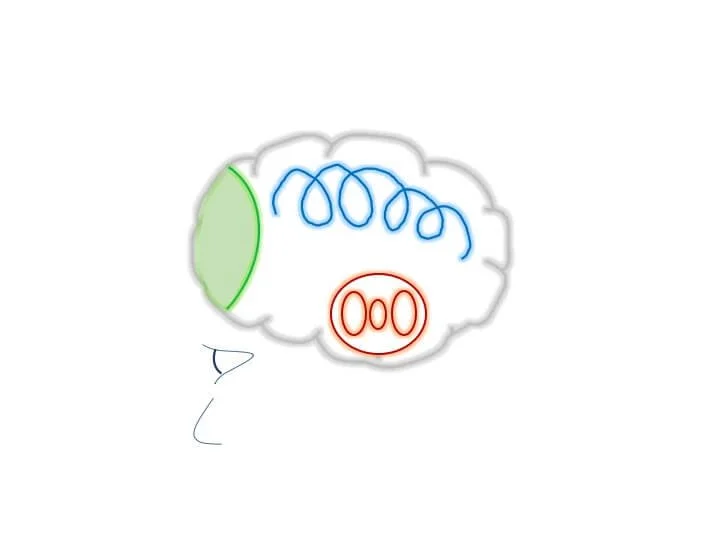
Understanding and visualising the brain can really help understand how stress happens and what we can do about it. This is something we will talk about in depth, and in direct relation to your experiences.
The green part a the front of our brain is what I call the "Conscious Mind". This is the part that is most active when we are awake, when we are focused on tasks or making decisions. This part is like a boss - good at taking charge and regulating activities - but like any boss, it can't do everything and it can occasionally get tired and overwhelmed.
The blue, at the top, sides and back, is like a really good team which, given clear direction from the boss, can figure out all sorts of ideas and plans, and make them happen, often without us having to consciously think about it. This is the "Subconscious Intellectual Mind".
And the red part, in the low centre of the brain, is the emotional centres. Half of this is dedicated to survival aka "Health and Safety". This is the part that's often known as the Fight or Flight system. I call it the "Primitive Mind" as it's not really evolved like the other parts of the brain. It's always trying to help, but it doesn't always get it right. In fact, in can be quite a negative part of the brain. When we are in fight or flight mode, we lose control of the higher functions of the brain. Conversely, when it is under control, other options and clear thinking become available again.